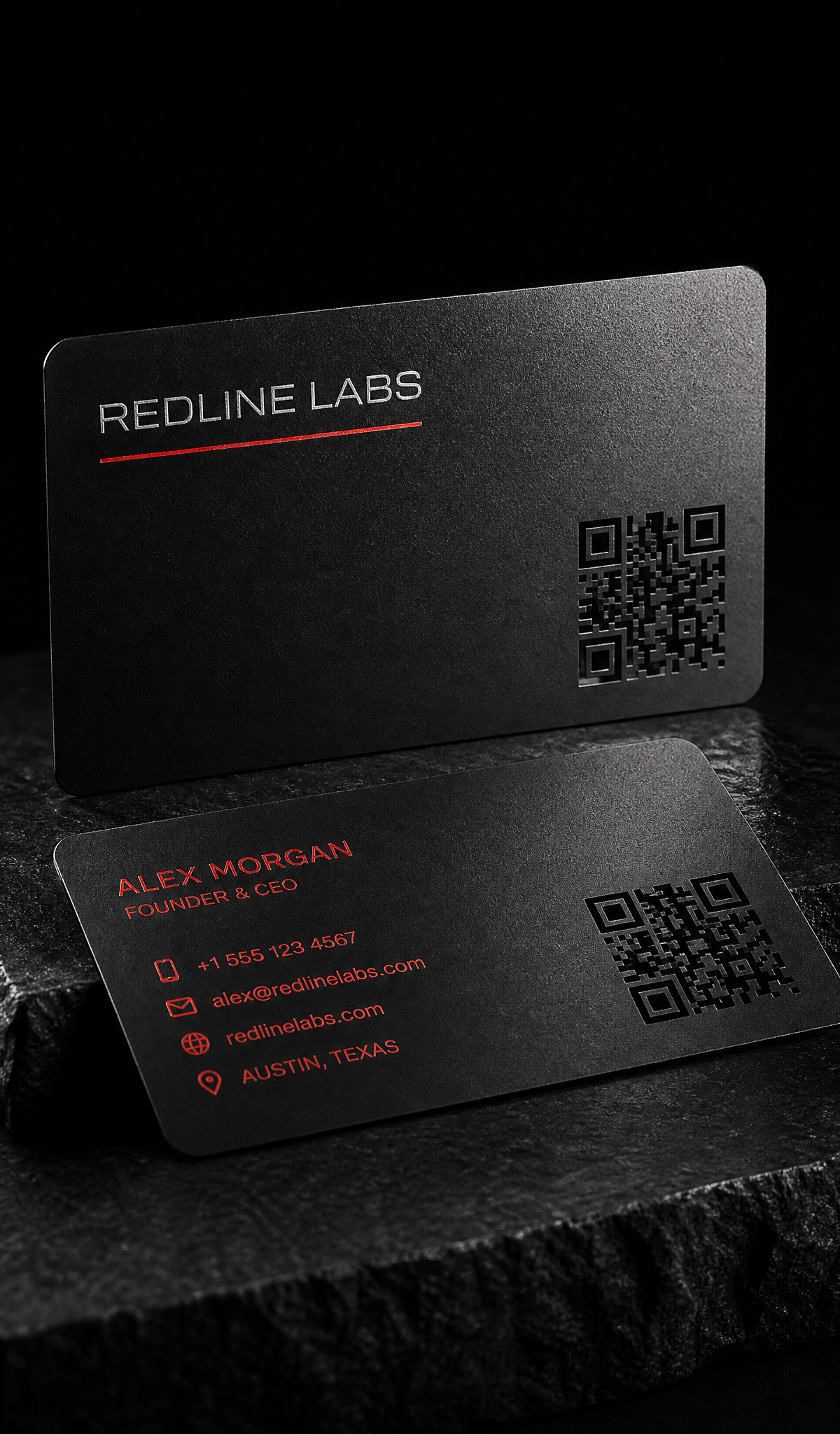
Forty-one ways to cut steel
A design exercise across six metals and four processes: which cut-throughs survive a wallet, and when enamel beats etch.
See the exerciseStainless steel and aluminum
Real stainless steel, cut to credit-card size and finished with a laser.
From $230 for 5 · $475 for 100 in silver stainless
About 3 weeks after proof approval (estimate).

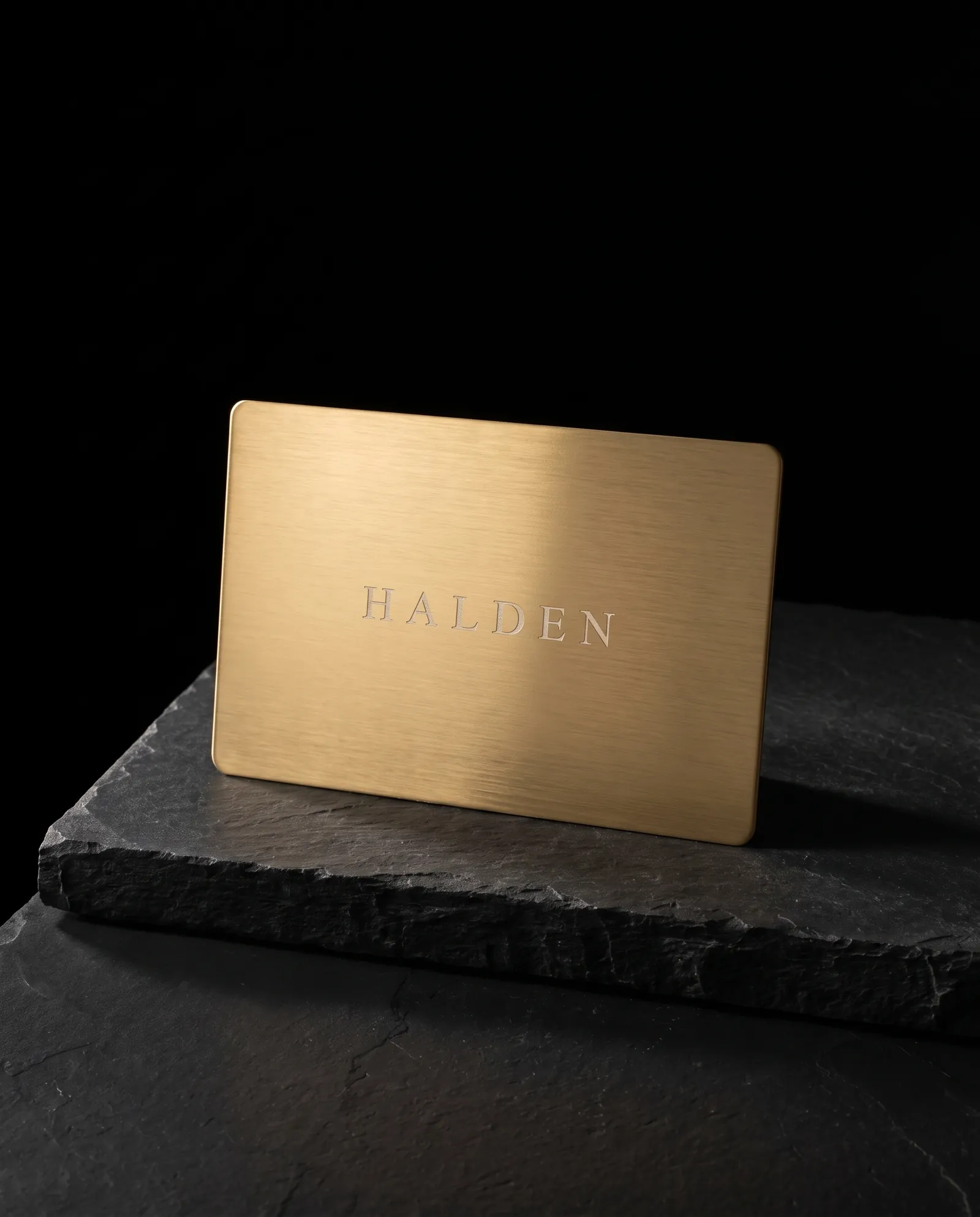

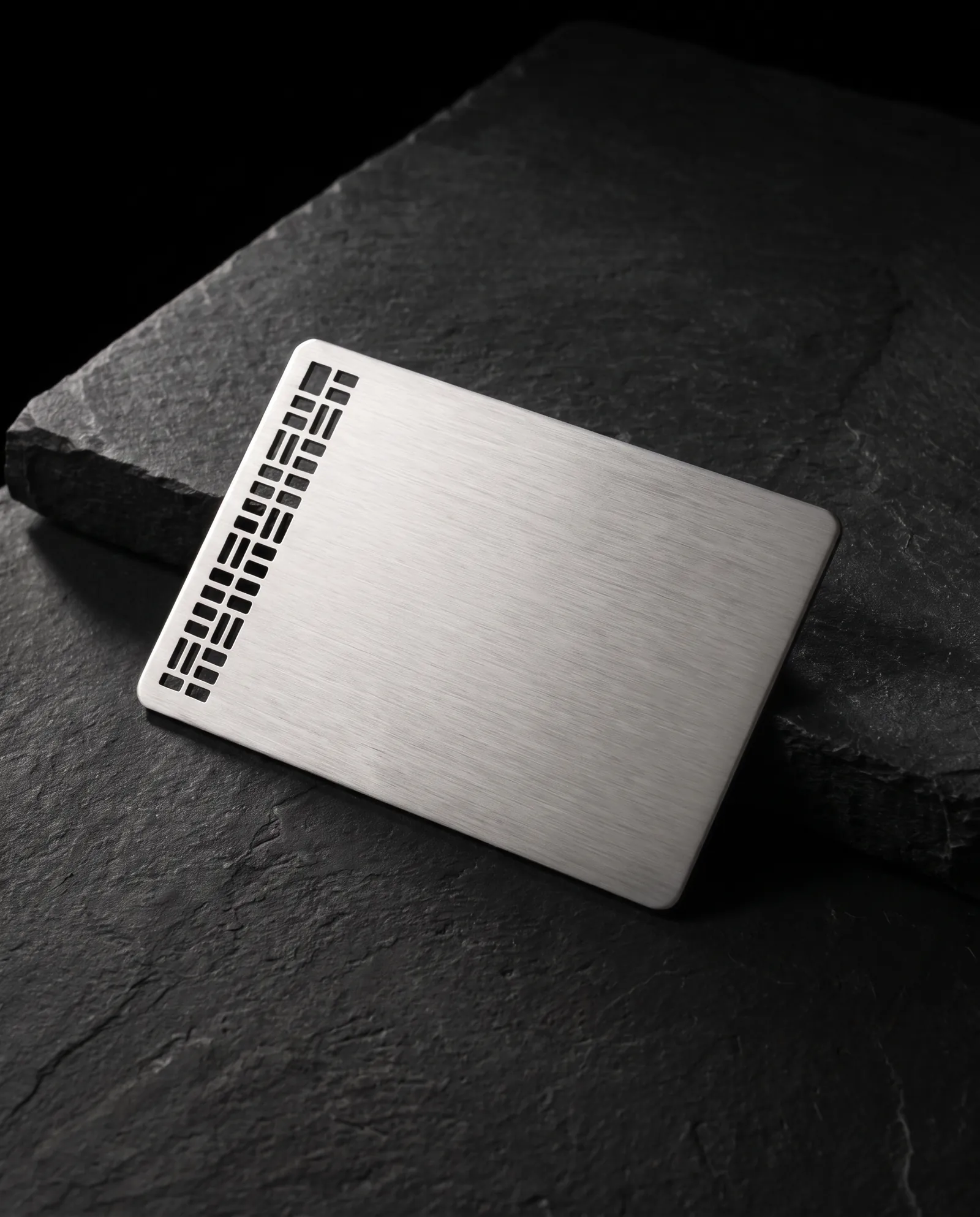
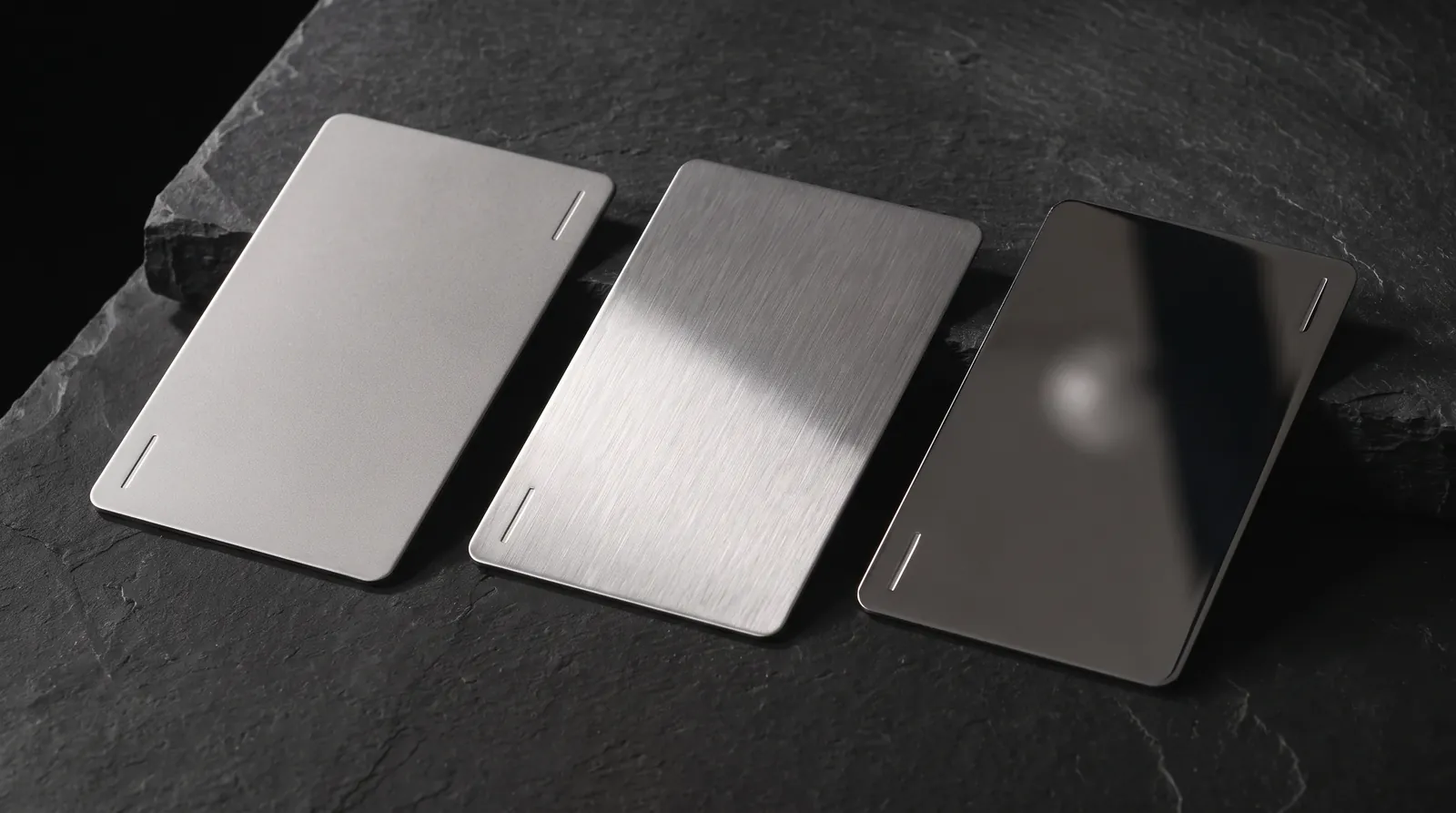
Metal business cards from Print Peppermint are real stainless steel, cut to credit-card size and finished with a laser: engraved, cut through, etched or color printed. Choose raw silver stainless; black, gold, rose gold, white, iridescent or copper-tone PVD-coated stainless; or lightweight aluminum. Runs start at 5 cards, and 100 silver cards cost $475, about $4.75 each, with a free proof and free shipping within the continental US. Production takes about three weeks after you approve the proof.
Metal & Color
Choose your metal
Stainless steel, heavy and corrosion-resistant. Colors are a PVD coating; the laser cuts through it to show bright steel. Aluminum is anodized and far lighter.
Thickness
Choose your thickness
0.5 mm is our standard: thinner than a plastic credit card but far heavier. 0.8 mm is about credit-card thickness and noticeably stiffer.
Quantity
If you're not happy, we reprint. How our quality promise works
Need something custom? Other sizes, papers, finishes or quantities → Get a custom quote
Feel it first: order the $8 sample kit
Not sure what to pick? Keep reading, we'll walk you through it.
Metal business cards from Print Peppermint start at $230 for 5 and run $475 for 100 silver stainless cards, about $4.75 each, with free shipping within the continental US and a free proof. The per-card price drops fastest between 5 and 100, so a run of 100 is where metal starts to make sense.
| Quantity | Total | Per card |
|---|---|---|
| 5 | $230 | $46.00 |
| 25 | $290 | $11.60 |
| 50 | $350 | $7.00 |
| 100 | $475 | $4.75 |
| 250 | $820 | $3.28 |
| 500 | $1,330 | $2.66 |
| 1,000 | $2,350 | $2.35 |
Silver stainless, matte, 0.5 mm, laser engraved, one or both sides. Shipping within the continental US included.
What moves the price: the metal (silver steel and aluminum are the base; black, white and iridescent cost the most), the finish (brushed and mirror sit slightly above matte), the add-ons (cut-outs +$85, color printing +$60, engraved QR +$30) and quantity.
| Spec | What it is | 100 cards |
|---|---|---|
| Essentials | Silver stainless, matte, engraved | $475 |
| Our pick | Black PVD stainless, brushed, engraved, with a cut-out | $730 |
| Full production | Gold PVD stainless, brushed, engraved, cut-out, color print on the front | $830 |
Our pick is black brushed for its contrast: the laser takes the black off and leaves bright steel, and the grain keeps fingerprints quiet.
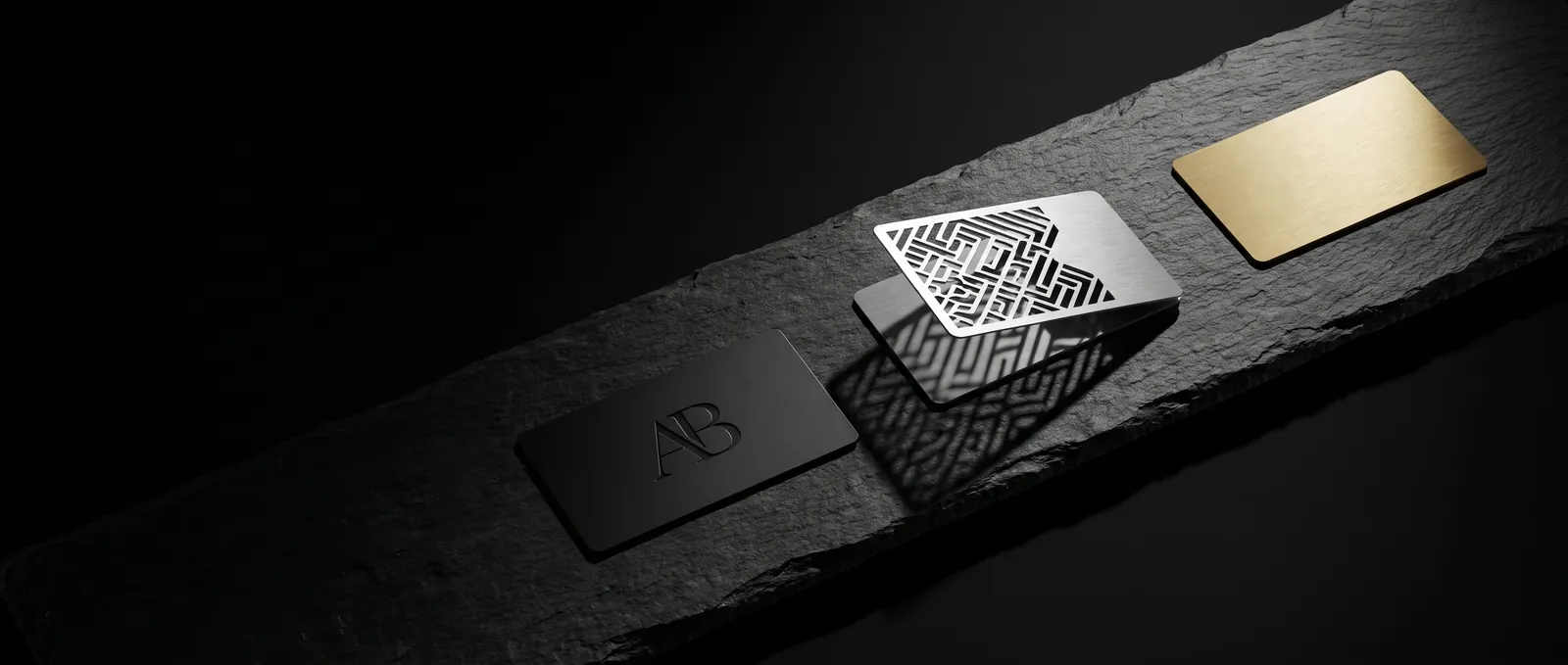
Every color except silver and aluminum is a PVD coating: a thin, hard layer of color bonded to stainless steel. The laser removes that layer to expose bright steel, so on every coated card your artwork reads as silver against the color.
| Metal | How the color is made | In the hand | Best technique | Worth knowing | From (100 cards) |
|---|---|---|---|---|---|
| Silver stainless | Raw steel | Heavy, cool | Engrave, etch, cut | Tone-on-tone engraving | $475 |
| Black stainless | PVD coating | Heavy | Engrave | Highest contrast; most ordered | $585 |
| Gold / rose gold stainless | PVD coating | Heavy | Engrave | Brushed hides prints best | $515 |
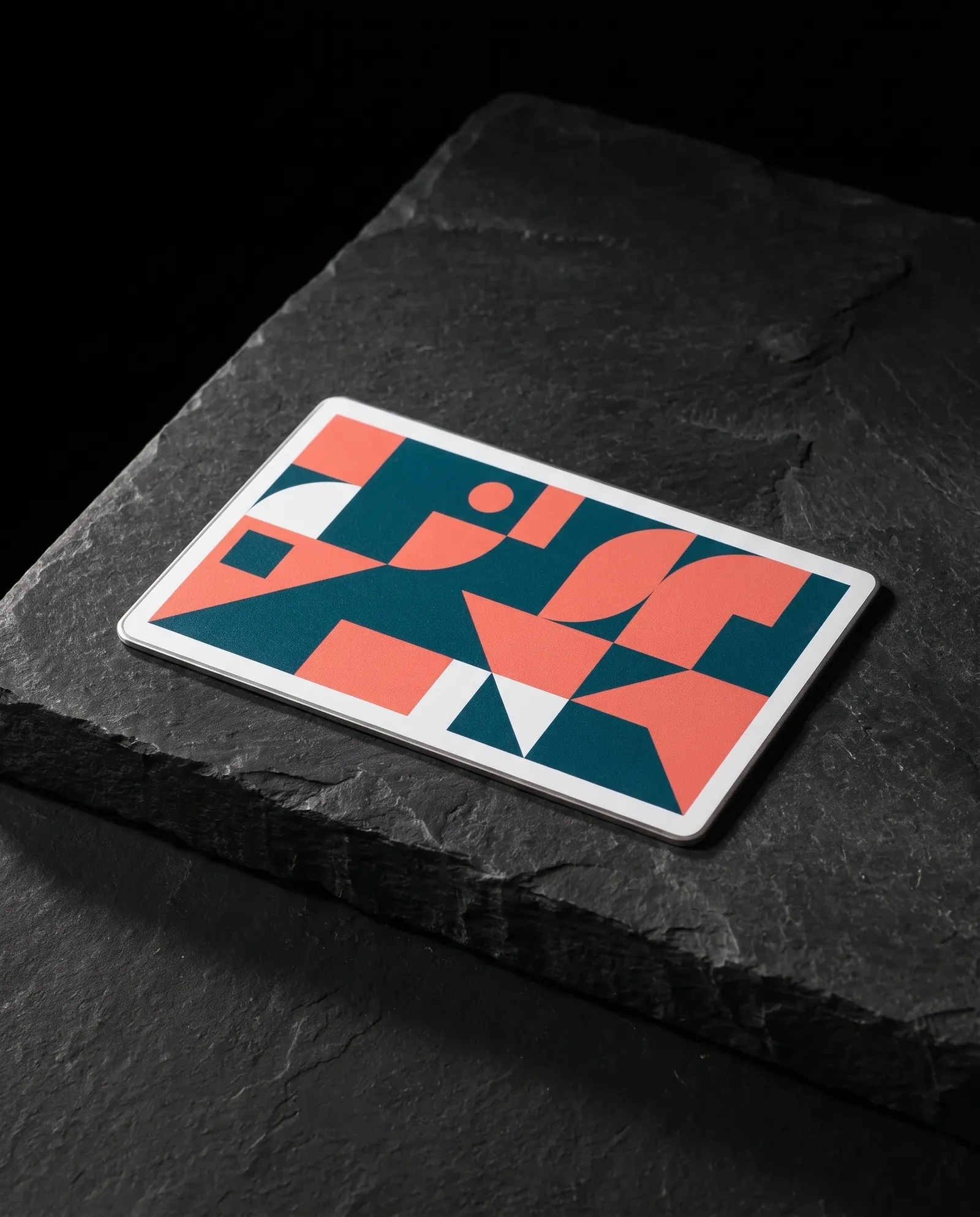
| White / iridescent stainless | PVD coating | Heavy | Engrave, color print | Truest base for color | $585 |
| Copper-tone stainless | PVD coating | Heavy | Engrave | Won't tarnish | $515 |
| Aluminum | Anodized | Much lighter | Engrave, color print | Easy to carry a stack | $475 |
Raw stainless. Engraving on bare steel is a frosted line on a grained surface: quiet, precise, the most engineered look we make. Add a color fill or cut-out if the logo must read at a distance.
The card most people picture, and the one we make most. People read a black card the way they read a black invitation: someone made a decision here. The laser lifts the black and the steel comes up bright, so even fine type has contrast with no ink. Matte is stealthier; brushed hides handling.
Warm and easy to overdo. A gold card with one strong mark looks like jewelry; a crowded gold card looks like it's compensating. Choose brushed over mirror unless you enjoy polishing.
White is the canvas for color printing; it doesn't shift your brand colors. Iridescent moves from pink to teal to gold as it turns, so keep the artwork minimal.
A warm, earthy tone on stainless steel. It's a coating, so it stays the color it arrives and won't patina.
Same footprint and techniques, a fraction of the weight. Handing out cards by the dozen? Aluminum spares your pocket. One card, one person, across a table? Stainless earns its weight.
Nothing on a metal card is pressed into a soft sheet. A laser engraves, cuts or etches the steel, and color goes on as a separate pass. Each technique has one thing to know before you design for it.
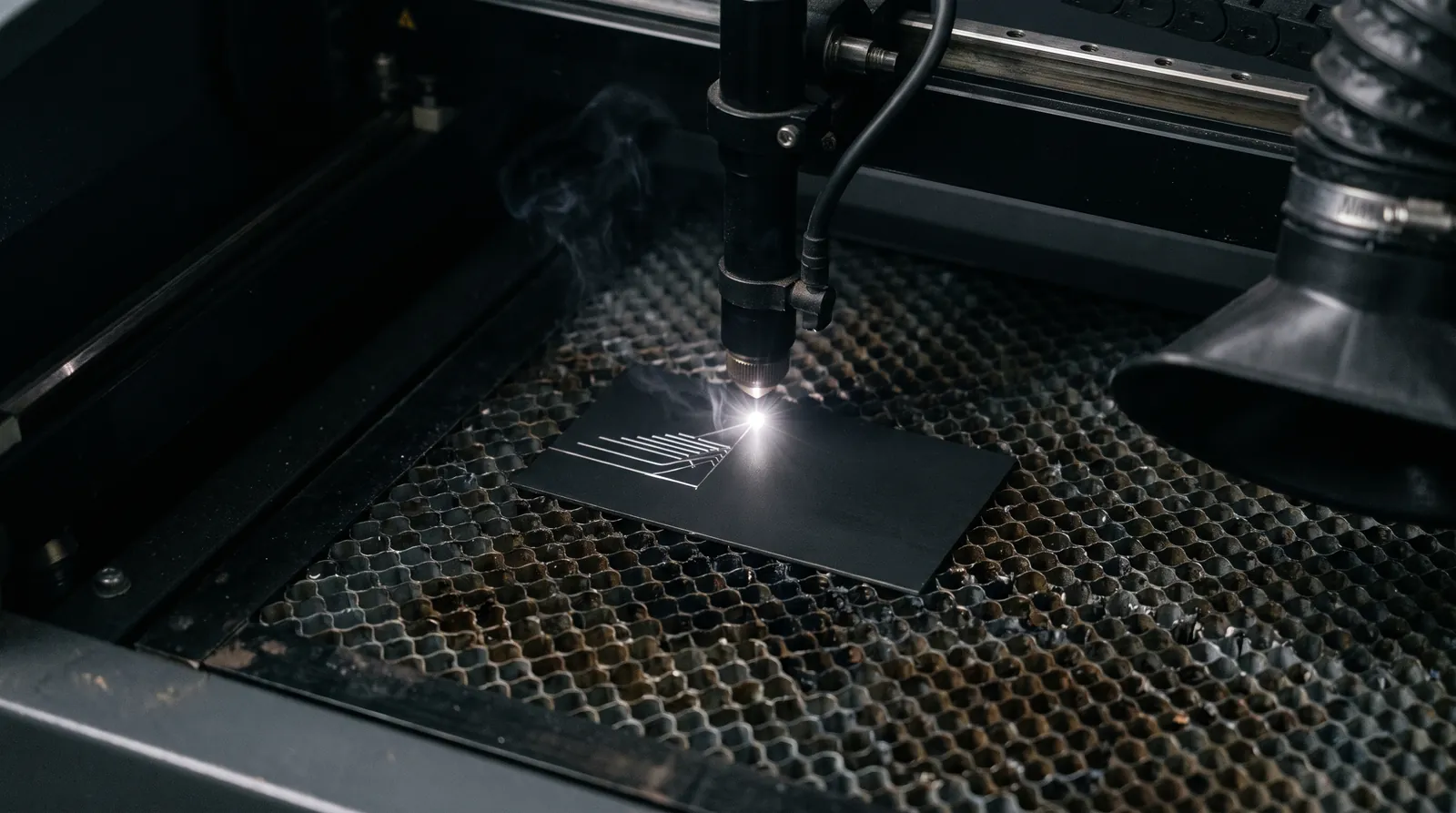
A focused beam removes the surface: on a coated card it strips the PVD layer to bare steel; on silver it frosts the steel itself. It's the base technique on every card, and it's permanent. The limit: engraving is binary, so gradients, soft shadows and photographs become one solid shape.
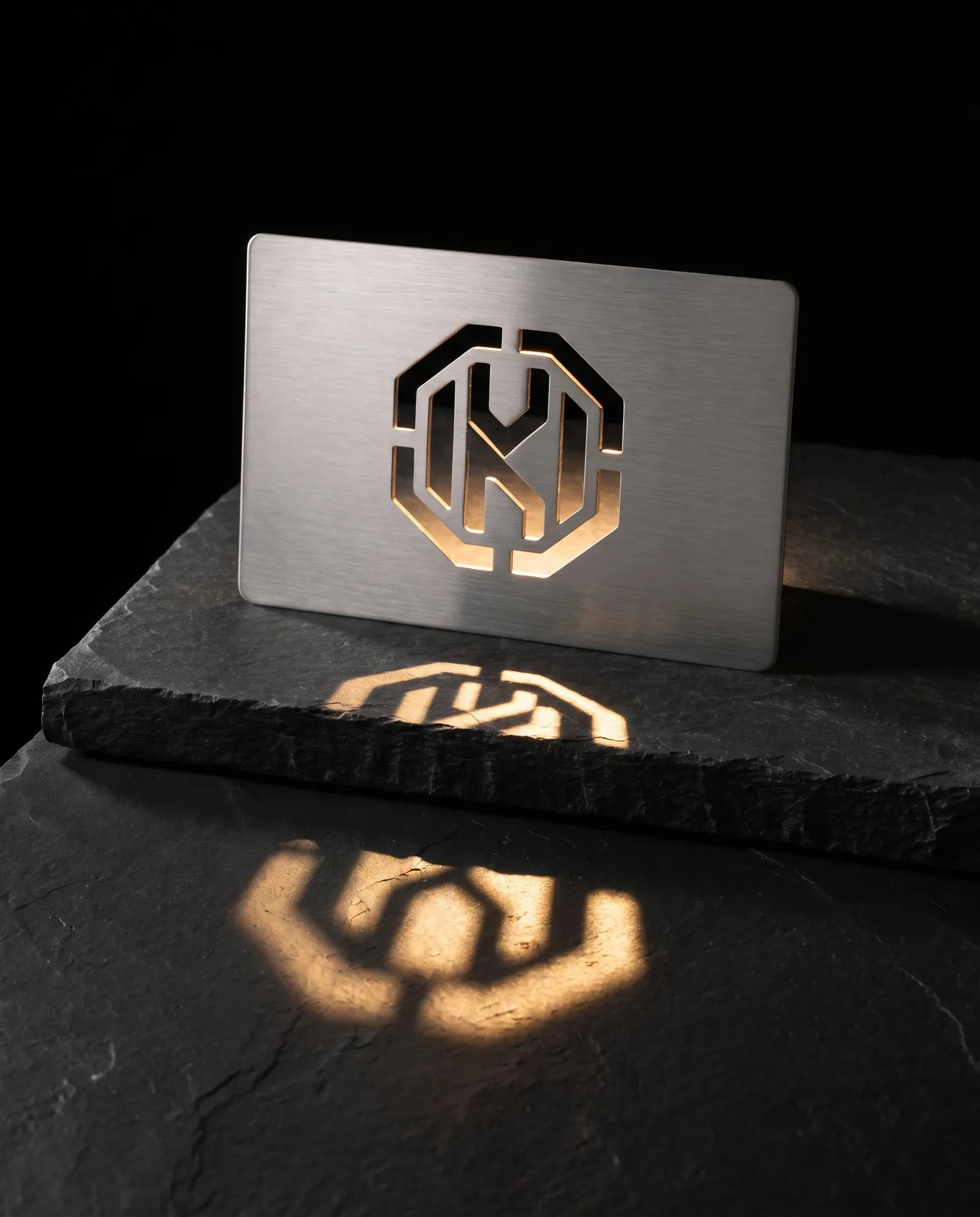
The laser goes all the way through, leaving a window or pattern that throws its shadow on the table. The limit: anything floating inside a cut falls out. The counter of an O or the island in a monogram needs small bridges tying it back, and we draw them with you, because where they land changes how the mark reads.
Etching bites a shallow recess into the steel: subtler than engraving, and you can feel it. Fill that recess with enamel in a brand color and the color sits below the surface, where a wallet can't wear it.
Brand colors and artwork that engraving can't carry are printed directly onto the metal, truest on white or silver steel. Our steer: bold, solid color looks engineered on steel. A full photograph usually looks like a sticker on a beautiful object.
Foil stamping, letterpress and embossing need a soft sheet to bite into, and steel doesn't give. So we never sell foil on a metal card; for that look we use mirror polish or a color fill, and a deep etch stands in for a deboss. Painted edges chip off steel, so color sits as a thin rim on the face and the cut edge stays bare.
What metal business cards are made of
More ideas: cool business cards
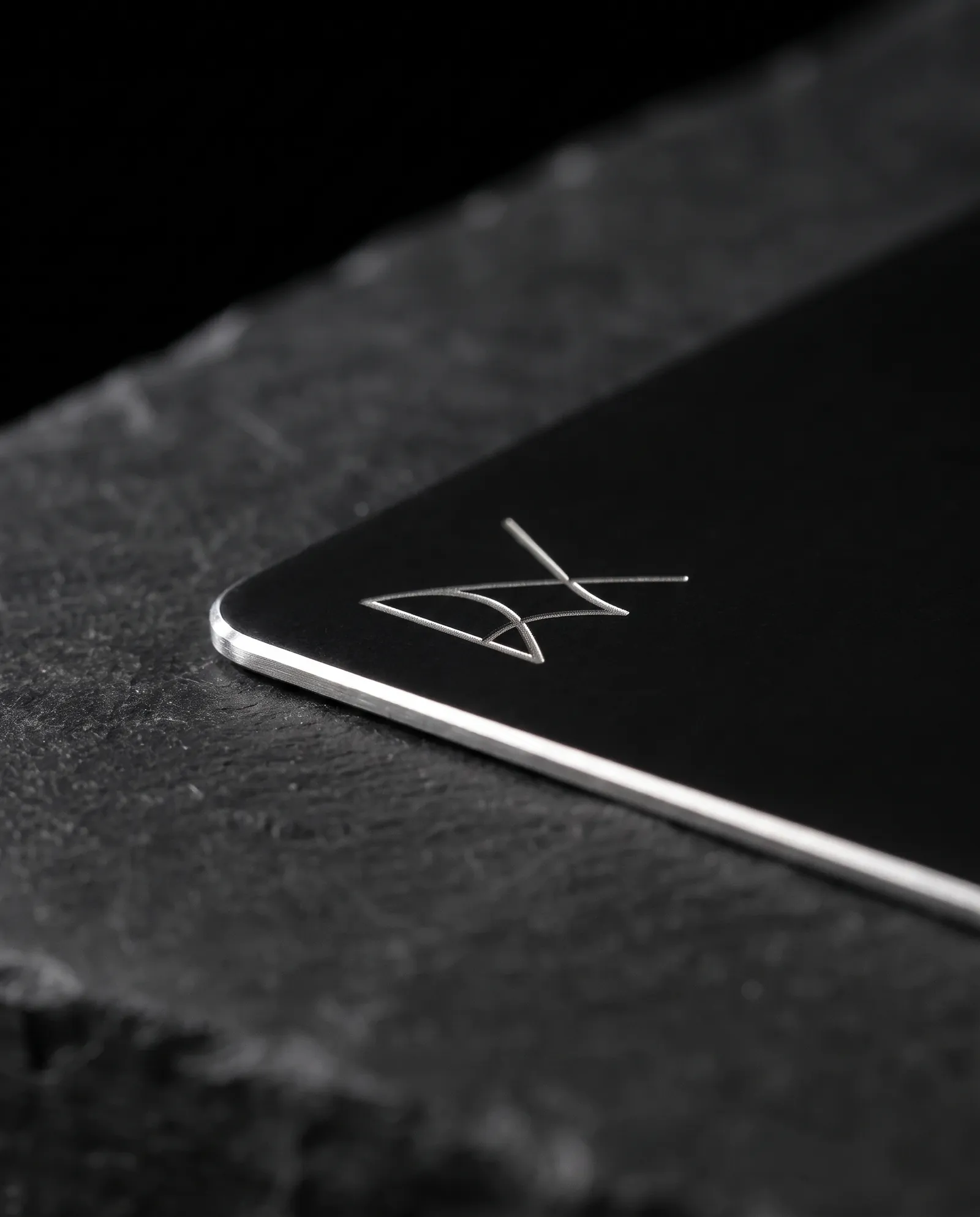
The finish decides how a card catches light, how sharp the engraving looks and how much it shows handling.
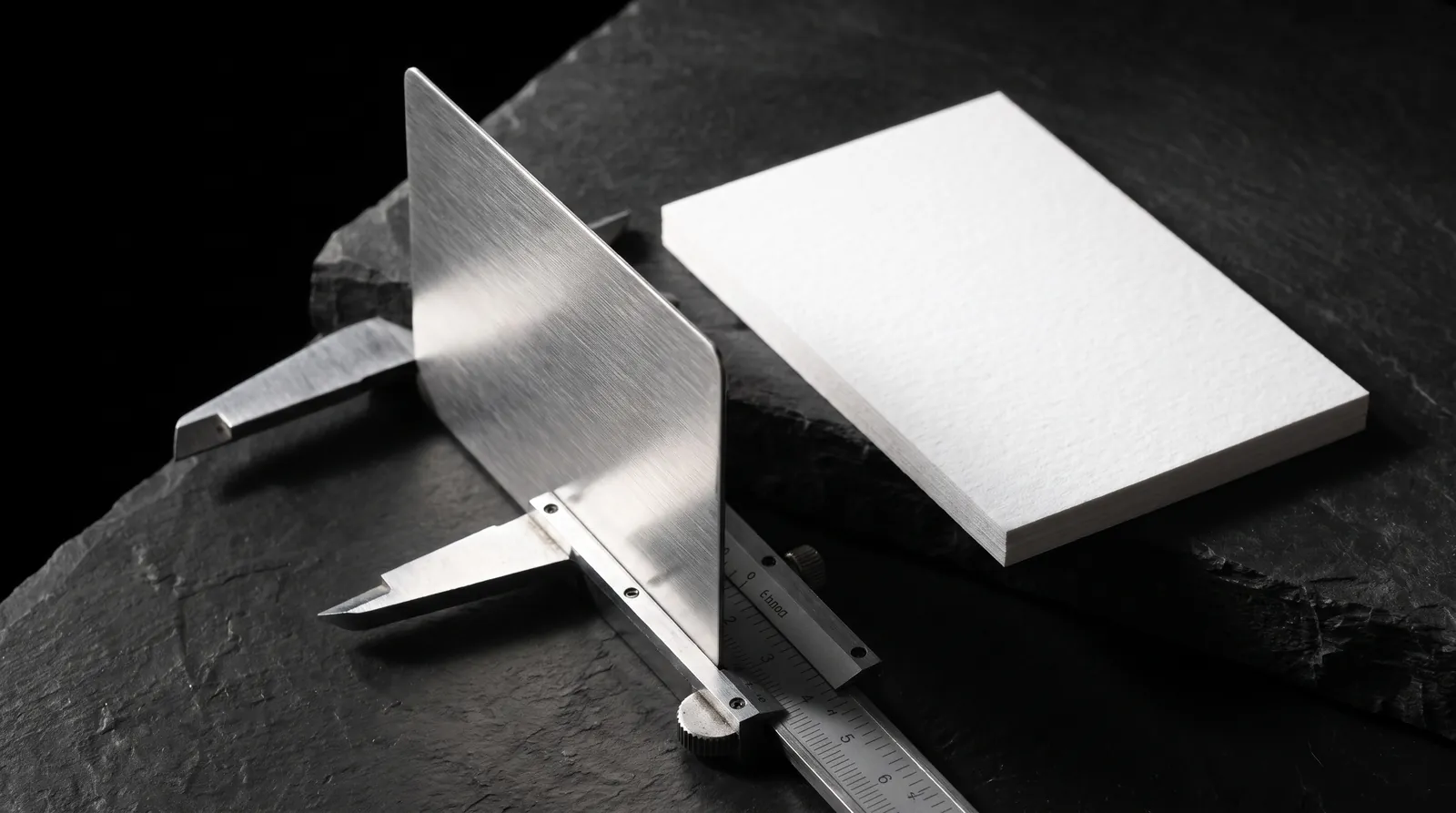
0.5 mm is the standard, and the one we'd choose for most people. It's thinner than a plastic credit card (about 0.76 mm) but, being steel, far heavier than paper and it doesn't flex. It slides into any wallet card slot.
0.8 mm is about credit-card thickness, stiffer and heavier, and costs a little more. Choose it when the card is the gift.
For scale, our 48pt cotton paper card is about 1.2 mm. Metal doesn't need thickness to feel substantial; density does that.
QR codes on metal are laser engraved and scan well with high contrast and a flat surface: matte or brushed black, or matte silver, at roughly 2 cm square with a clear margin. Mirror finishes reflect the camera and scan unreliably. We test-scan every QR at proof. Is a QR worth adding? Yes, if it points at a short link you control, so you can change the destination later without reprinting steel.
NFC on metal starts with an honest fact: solid steel blocks the signal. Our NFC metal business cards bond a stainless front to an NFC-enabled printed back; the chip sits in the back layer and reads when a phone taps that side. They start at $229 for 25. An all-steel look is possible with a pocketed or windowed build that gives the signal a way out; we quote those individually. And NFC is nothing exotic: the chip holds a link, and a phone reads it only from a few centimetres away, when someone chooses to tap.
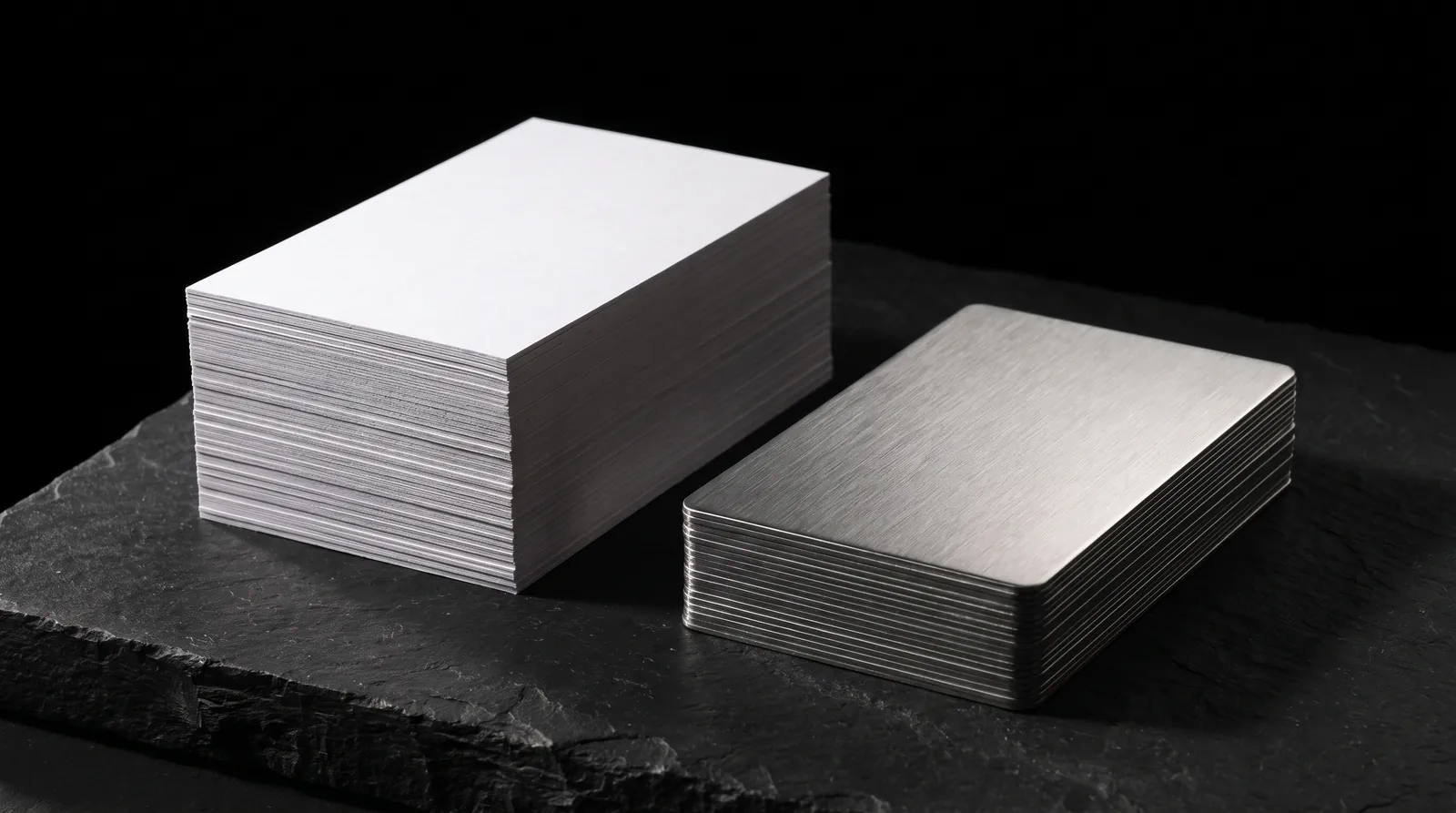
Are metal business cards worth it? Yes, as a select run for the people who matter, not as a blanket handout at a trade show. We usually suggest keeping a paper run for everyday use. Same brand, two registers.
| Compare | Metal (stainless) | Premium paper (32pt cotton, foil) | Plastic (PVC) |
|---|---|---|---|
| Per card at 100 | about $4.75 | Get a price | $1.36 |
| Weight in hand | Heavy, cold, lands with a sound | Soft, thick, tactile | Light, smooth |
| Durability | Doesn't bend, tear or wear | Edges soften over months | Waterproof, flexible |
| Write a note on it? | No | Yes | Barely |
| Signature techniques | Engraving, cut-outs, etching, color fill | Foil, letterpress, emboss, painted edges | Foil, spot UV, clear or frosted |
| Best for | The handoff that matters | Everyday networking with craft | Durable, see-through, NFC at lower cost |
If you need to write on your cards, hand out hundreds, or want foil and letterpress, paper is the better call, and we make that too.
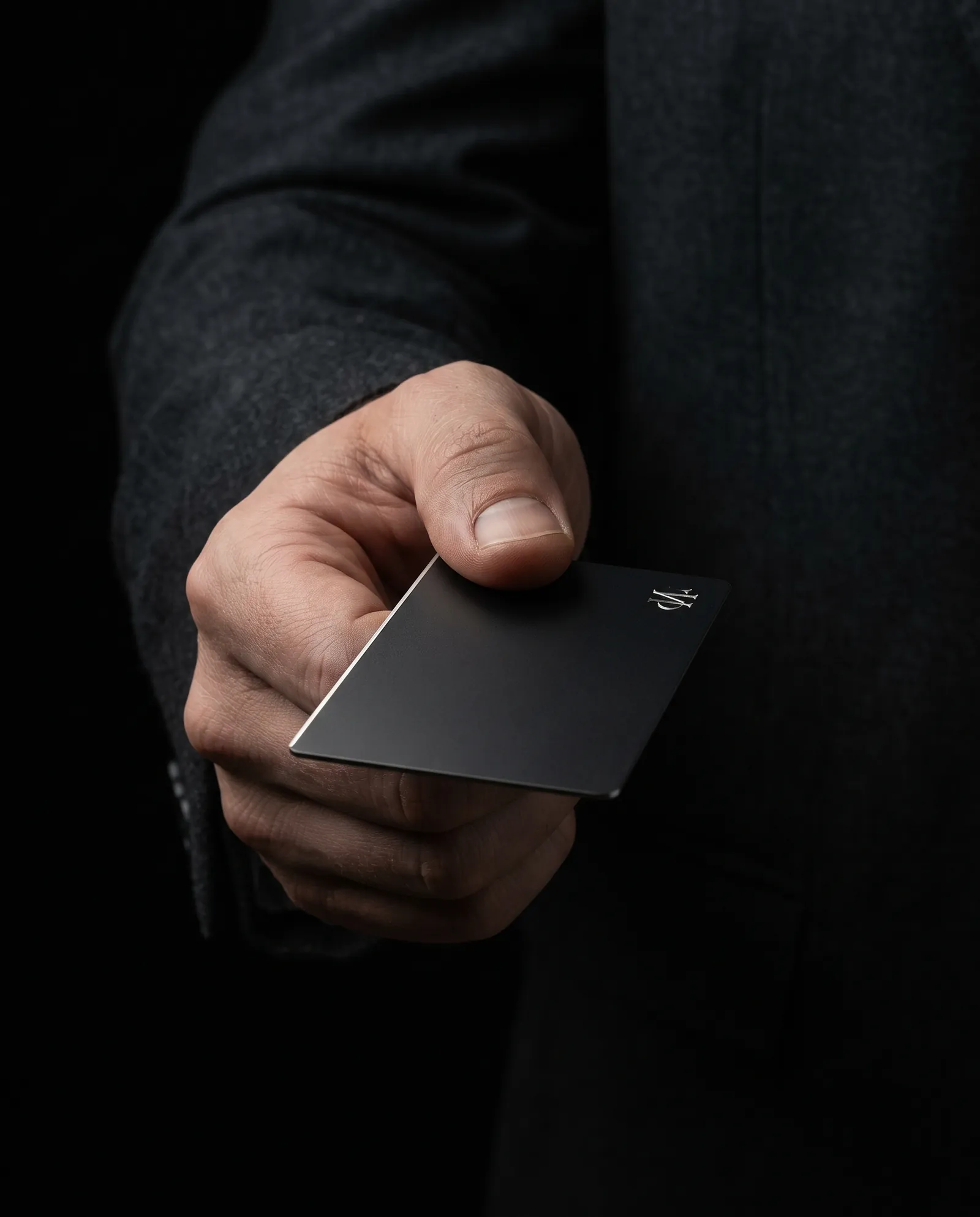
Founders, real estate agents, creative directors and anyone whose card gets handed over once, deliberately, across a table. Contractors and builders order black steel for the owner's pocket and the big bid; see our construction business cards. Metal also suits VIP and membership cards, where the card is part of the experience. For paper builds with the same weight, see our luxury business cards. Three pieces of our work show how we think about it:
A design exercise across six metals and four processes: which cut-throughs survive a wallet, and when enamel beats etch.
See the exercise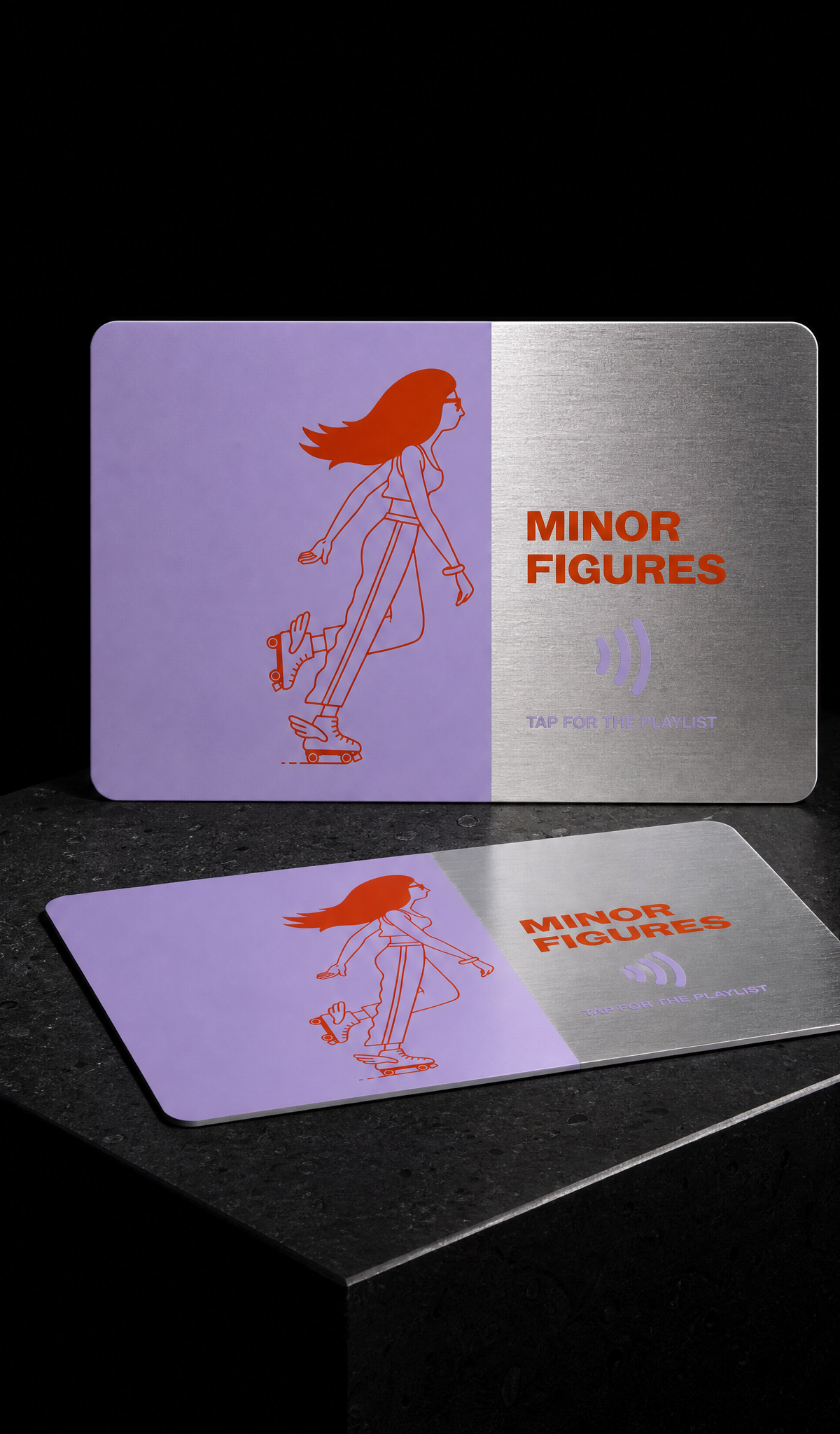
Minor Figures' hybrid stainless and PVC NFC card for a product launch: two Pantone silkscreen colors and a tap that opens a playlist.
Read the Minor Figures case study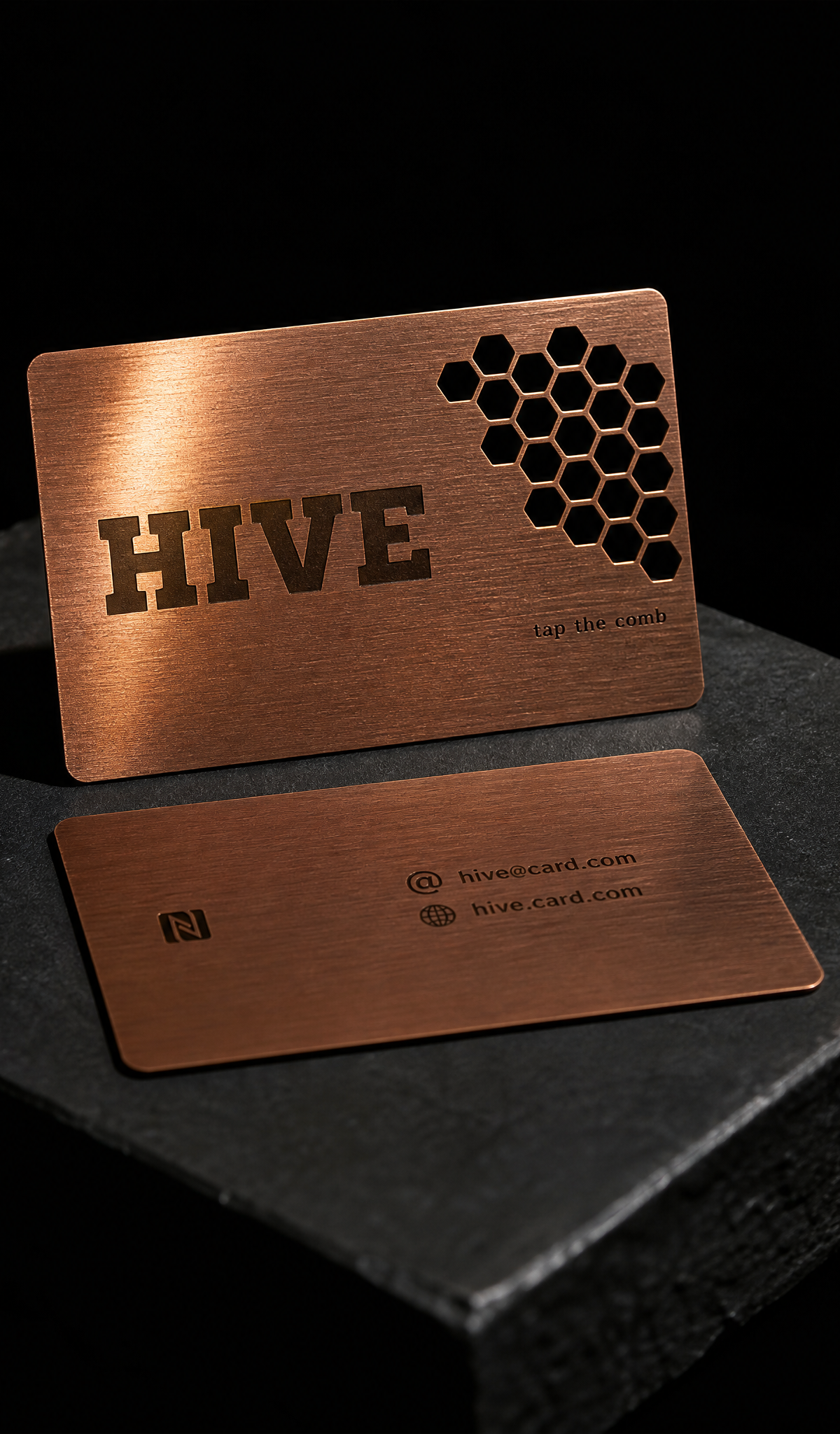
A design exercise in NFC construction: inlay windows, edge strips and a honeycomb cut-through over the chip.
See the exerciseThe most common mistake we see on any business card is type that's too small and too fine for the process, and on steel it's fatal. Most files need a few changes before they're engraved. We check these at proof:
Cards are credit-card size with 3 mm rounded corners. If your logo won't survive these limits, our designers redraw it before anything is cut. See all business card sizes.
Metal business cards take about three weeks after proof approval. That's an estimate: laser time and finishing scale with quantity, so 1,000 cards isn't the same job as 100.
Working back from a date: allow about four weeks from proof approval to cards in hand, production plus transit. Tell us your date before you order and we'll say honestly whether it's realistic, and what would have to give to make it.
Shipping within the continental US is free. If you're not happy, we reprint.
Yes, used selectively. A metal card tends to get kept and passed around in a way paper usually doesn't, but at several dollars a card it's the wrong tool for handing out by the hundred. What works: 100 metal cards for the meetings that matter, paper for everyday networking.
Metal business cards start at $230 for 5. 100 silver stainless cards cost $475, about $4.75 each, and 1,000 cost $2,350. Coatings, finishes, cut-outs and color printing add to that. Every order includes a free proof and free continental US shipping.
Stainless steel, for most people: heavy, rigid, rust-resistant, and available in black, gold, rose gold, white or iridescent PVD. Aluminum is better when you hand out cards in quantity. We don't make titanium cards; stainless gives the look and weight for far less. You can order custom metal cards right here: pick the metal, finish and quantity at the top of this page, or send us a brief for anything the configurator doesn't cover.
They cost several times more per card than premium paper. You can't write a note on them. Mirror finishes show fingerprints. A box of 100 is heavy. And they can't take foil stamping, letterpress or embossing. If any of that matters, keep a paper run alongside.
Not as scrap; a 0.5 mm card is under 20 grams of steel. Their value is that they last. Stainless doesn't rust, bend or wear at the corners, so the card kept in a drawer still looks right years later.
Yes. They're credit-card size and slide into any standard card slot. At 0.5 mm a stainless card is thinner than a plastic credit card; 0.8 mm is about the same thickness, and stiffer.
A little. Matte black shows skin oils more than brushed black, and both wipe clean with a microfiber cloth. Mirror shows the most. If fingerprints bother you, choose brushed.
A full-color logo, yes: color is printed directly onto the metal, and it reads truest on white or silver stainless. Engraving can't carry color or gradients; it's a single tone. Photographs are the weak spot. Bold, solid color looks engineered on steel, while a photo tends to look like a sticker, so we'll usually steer you to a solid-color version of the idea.
Both. QR codes are laser engraved at about 2 cm and scan best on matte or brushed black; we test-scan every one at proof. Steel blocks NFC, so our NFC metal cards pair an engraved steel front with an NFC-enabled printed back that phones tap.
For the life of the card. Engraving doesn't add anything that can rub off: it removes the coating or frosts the steel itself, and stainless doesn't rust in normal use.
You can, with a fiber laser and patience. Professional production adds the hard parts: bridged cut-outs, PVD colors, enamel fill, a proof that checks every stroke, and hundreds of cards that match.
About three weeks after you approve your proof, plus transit. That's an estimate, not a guaranteed delivery date. Need them sooner? Tell us the date before you order and we'll tell you honestly whether it's realistic.
Yes, arguably more than before. Plenty of people now swap details by phone, QR code or LinkedIn instead, and that's exactly why a physical card gets noticed. A heavy one gets remembered. Add NFC or a QR code and it does the digital job too.
A single card in a wallet is a small piece of steel, like a key or a coin. A full box of 100 is a dense block that may get a second look at the X-ray, so if you're flying with a run, pack it in your carry-on and expect it may be checked.
Our $8 sample kit includes real stainless steel, so you can feel the weight before you spend real money. Planning more than 1,000 cards, several names, an all-steel NFC build or a mix of techniques? Send us the brief and we'll price the full spec, then show you what each step down saves.
Black cards in paper? See black business cards.