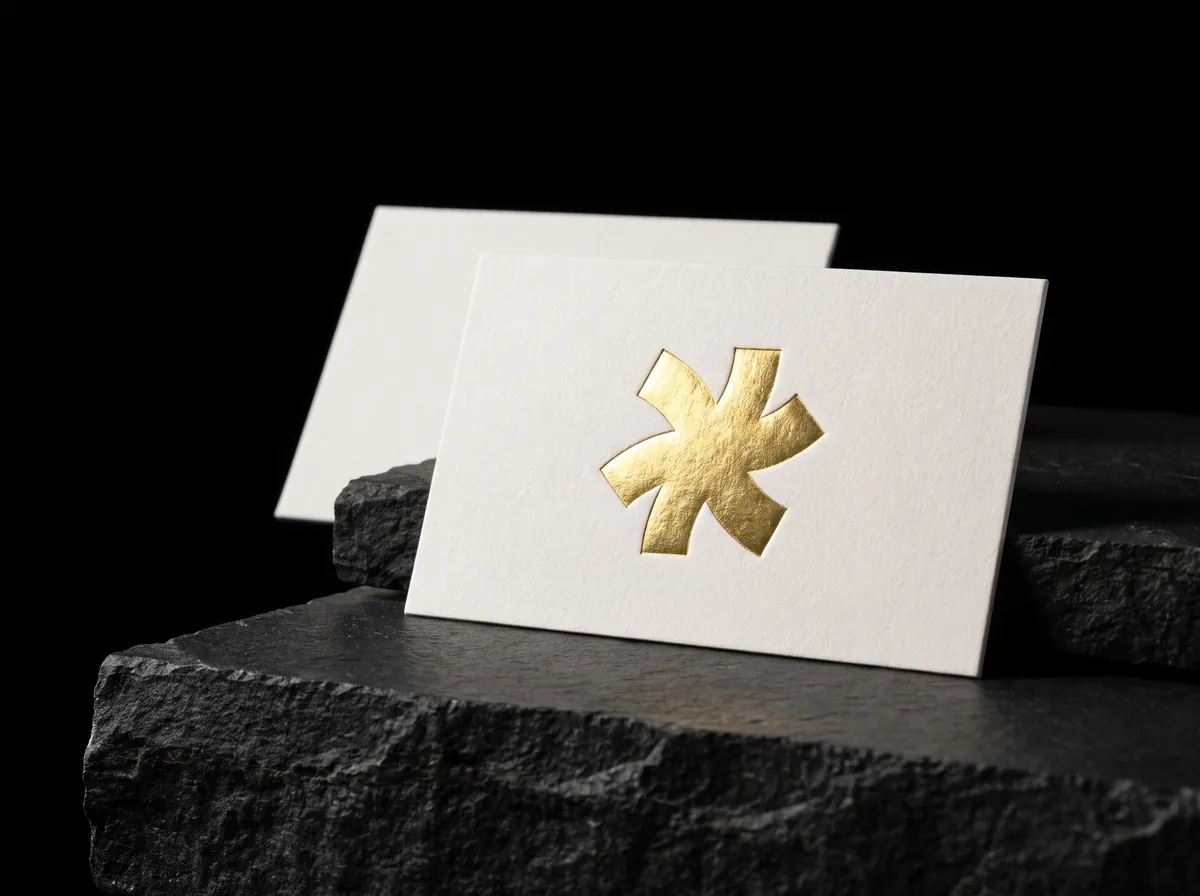
Standard Plastic
20pt PVC (about 0.5 mm) in clear, frosted or white. Rounded corners included. Credit-card or US standard size.
From Get a price for 100
Ships in 3–4 business days after proof approval (estimate)
Clear, frosted, white, black
Rigid, waterproof PVC, the same material as a credit card.
Standard from Get a price for 100 · Custom from Get a price for 250
Standard ships 3–4 business days after proof approval; Custom about 3 weeks (estimates).
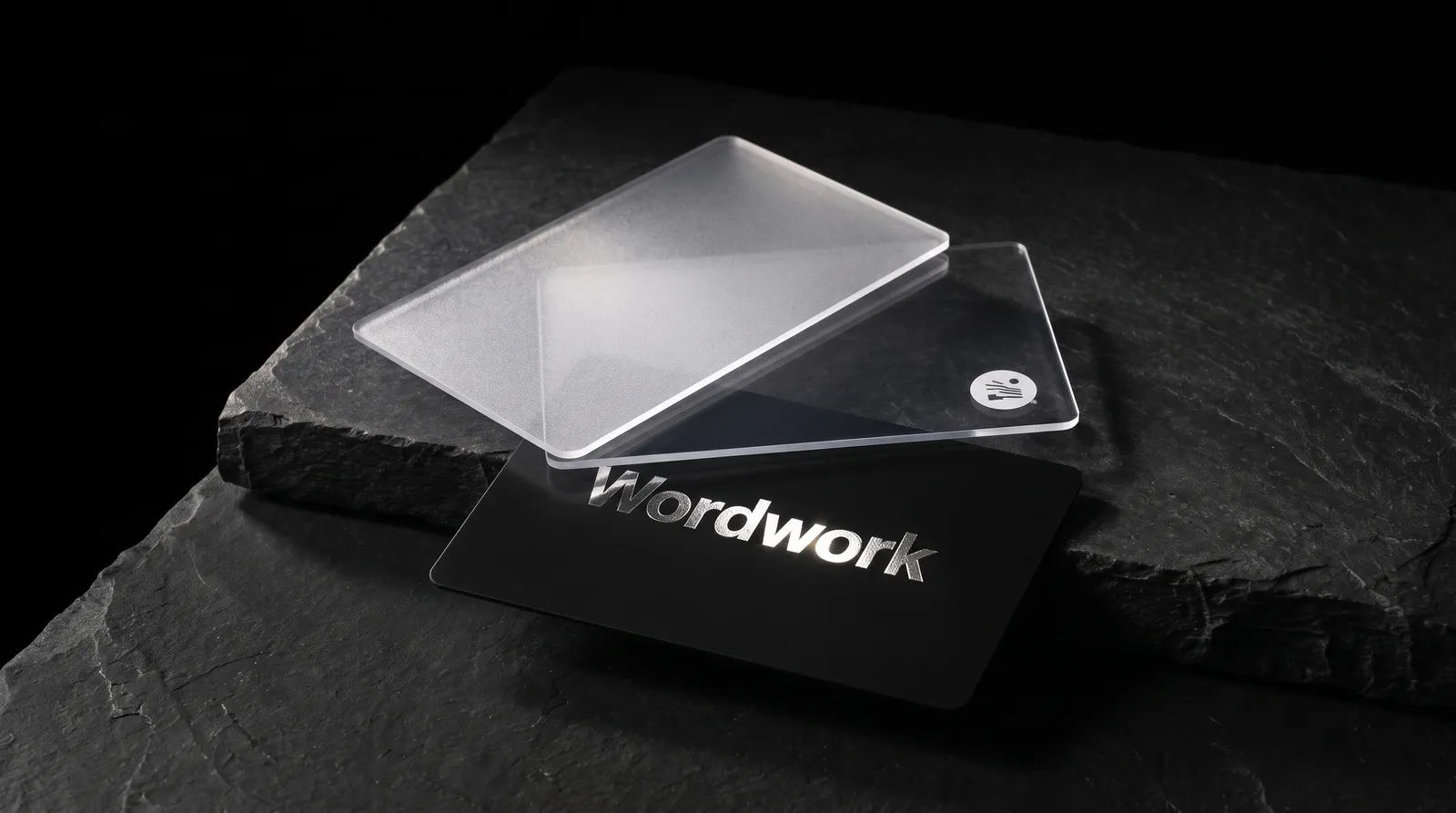
Plastic business cards are printed on PVC, the same rigid, waterproof material as a credit card. We make them two ways. Standard is 20pt clear, frosted or white plastic, from a quoted price for 100, and ships in 3–4 business days after proof approval. Custom is 30pt, true credit-card thickness, with white ink, foil, spot UV and two-sided printing on clear, from a quoted price for 250 and about 3 weeks after proof approval. One thing to know first: on clear plastic, white and pale colours disappear unless we print a white layer behind them.
20pt PVC (about 0.5 mm) in clear, frosted or white. Rounded corners included. Credit-card or US standard size.
From Get a price for 100
Ships in 3–4 business days after proof approval (estimate)
30pt PVC (about 0.76 mm, credit-card thickness) in clear, frosted or white; black on request. White ink, foil, spot UV, two-sided print on clear.
From Get a price for 250
About 3 weeks after proof approval (estimate)
Want a tap-to-share chip inside? NFC plastic cards start at $149 for 25.
Not sure which stock? Hold frosted plastic first: order the $8 sample kit
Plastic business cards cost Get a price for 100 on our Standard line, about Get a price a card, and the per-card price drops fast with quantity: at 1,000 it's about $0.31. Custom 30pt starts at 250 cards because each run is set up from scratch around your artwork, and a foil die is made for your mark if you add foil. Every price below includes a designer's proof and free shipping within the continental US.
| Quantity | Total | Per card |
|---|---|---|
| 100 | Get a price | — |
| 250 | Get a price | — |
| 500 | $284 | $0.57 |
| 1,000 | $313 | $0.31 |
| 2,500 | $699 | $0.28 |
| 5,000 | $1,327 | $0.27 |
| Quantity | Total | Per card |
|---|---|---|
| 250 | Get a price | — |
| 500 | $410 | $0.82 |
| 1,000 | $515 | $0.52 |
| 2,000 | $810 | $0.41 |
| 5,000 | $1,490 | $0.30 |
White ink from +$40 · Foil stamping from +$60 · Spot UV from +$50 · Two-sided printing on clear or frosted from +$30.
We price the full build first, then show you what each piece saves when it comes off. On clear plastic, the white layer is the one add-on we'd keep: without it, your type is a tint on glass. Foil and spot UV are the ones to drop if the number is tight.
The plastic you choose decides how your ink reads, more than any finish you add. Clear shows everything behind it. Frosted softens it. White and black are opaque. Here's what each looks like in the hand, including the part that surprises people.
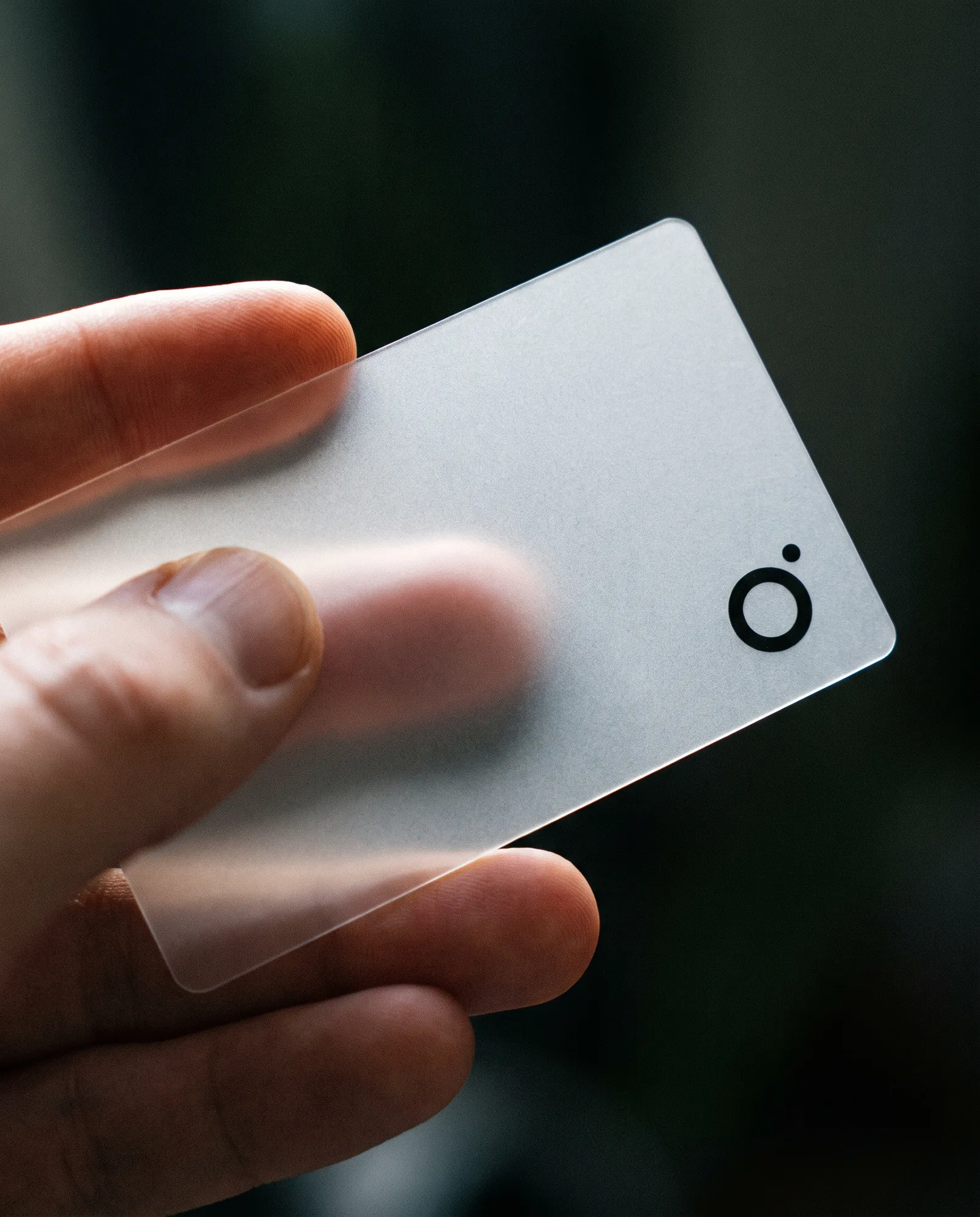
Translucent PVC with a soft matte surface. Colour reads well, scuffs and fingerprints hide in the frost, and you can see the shadow of a thumb through it. Where it surprises people: frosted takes on whatever is behind it. On a white desk it glows; against a sleeve or a black wallet it reads gray. Our recommendation for most designs. Available on Standard and Custom.
Frosted plastic in the materials library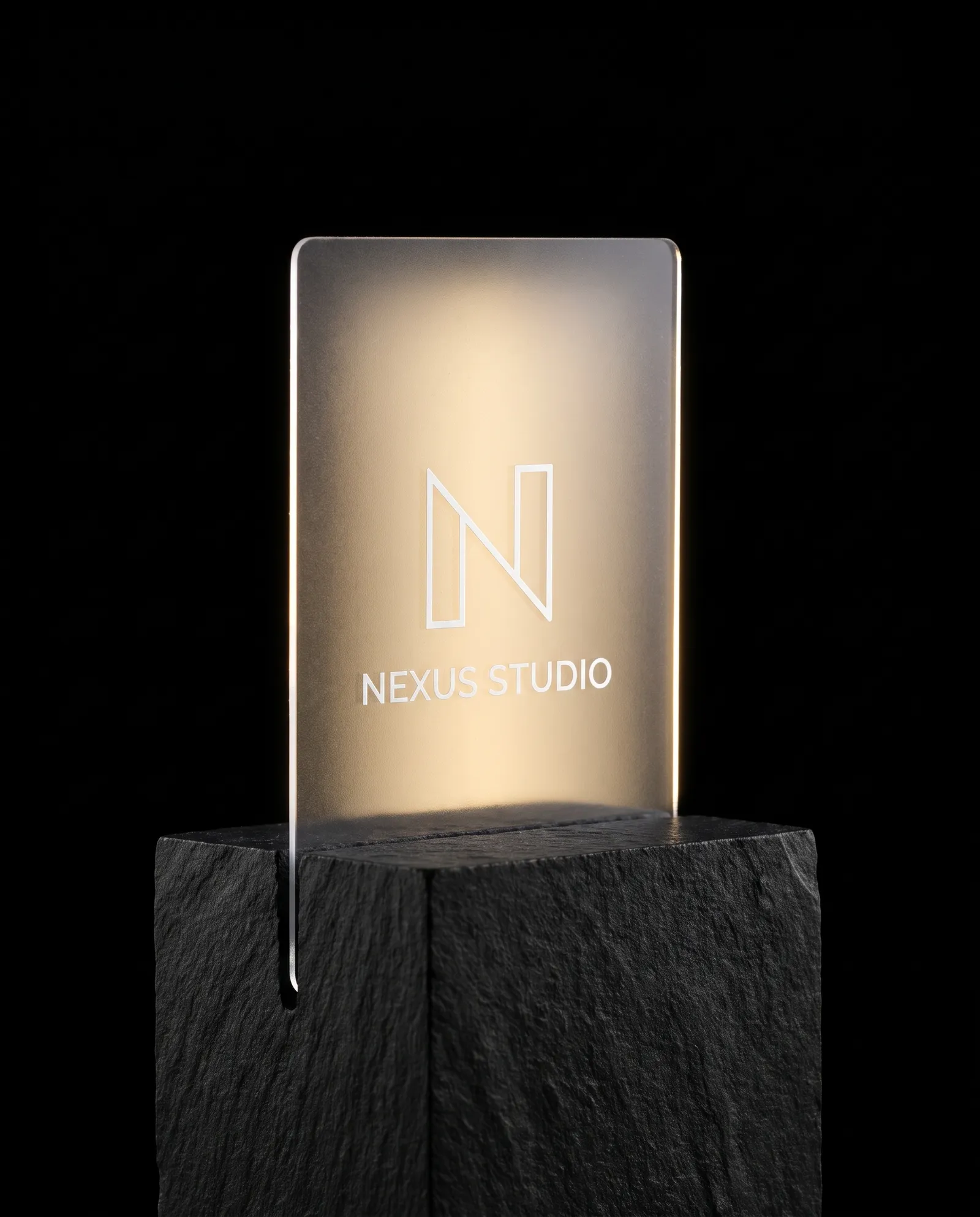
Fully transparent, glossy PVC. Your design appears to float. The catch: ink on clear is a tint, not a solid. White, pastels and thin type nearly vanish unless a white layer is printed behind them, and on a table the card reads almost black. Best with bold, marks, or with a white underprint on Custom. Standard clear prints one side.
Clear plastic in the materials library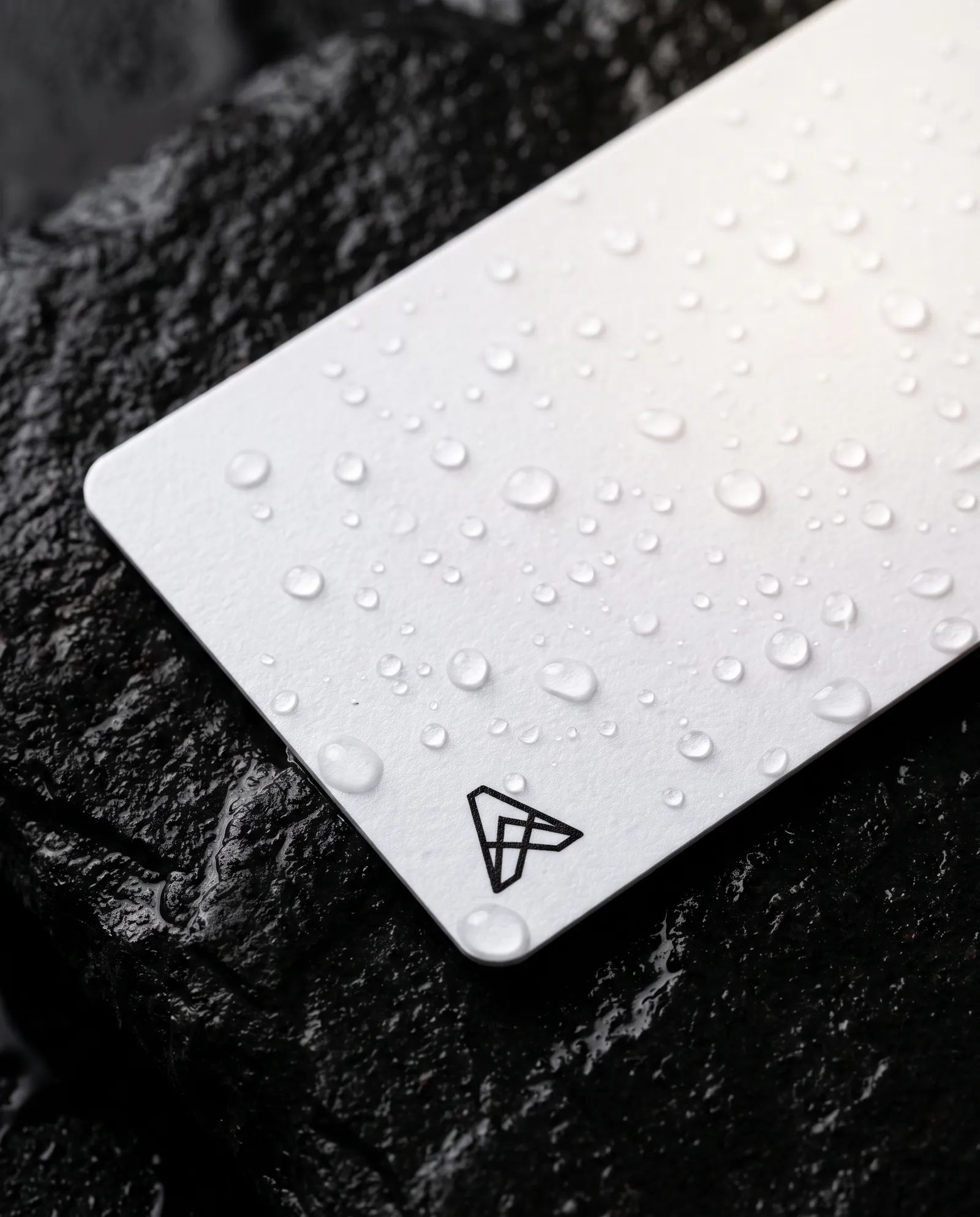
Solid, opaque white PVC. It prints full colour edge to edge on both sides, like a rigid, waterproof version of a coated paper card. No transparency tricks, no surprises. The pick when the card has to carry a photo, a busy back or a lot of colour.
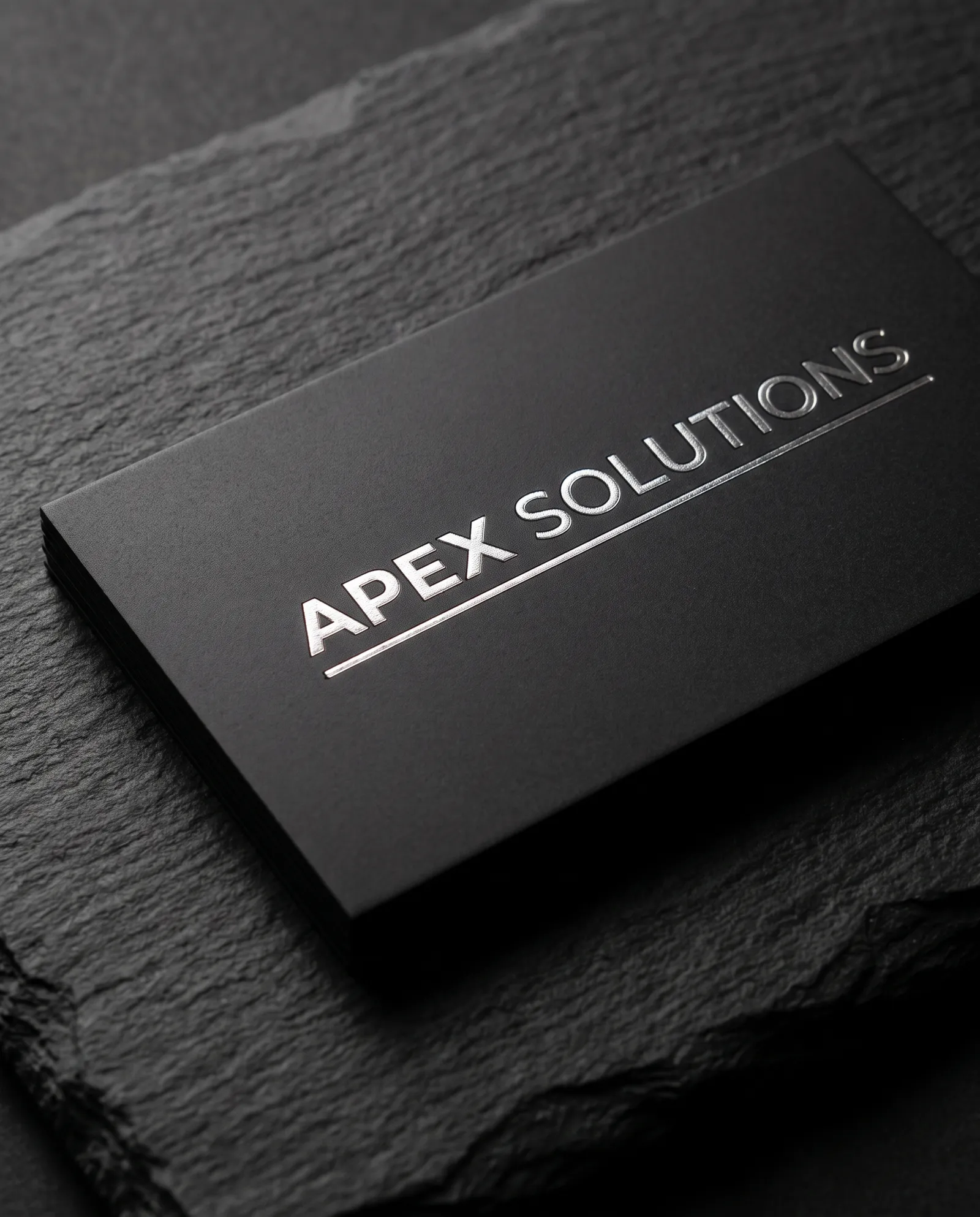
Opaque black PVC. Ordinary ink disappears on it, so black cards are decorated with foil, white ink, or colour printed over a white layer. Silver foil on black plastic reads like it was machined into the card. Black is a Custom build; tell us you want it in the notes or a quote request.
Our 30pt plastic is about 0.76 mm, the thickness of a standard credit card, and it feels like one: stiff, cool, with a clean snap when you flex it. Standard 20pt is about 0.5 mm. It's still rigid plastic, still waterproof, but it bends more in the hand and reads lighter.
Pick 20pt when you need cards in days or you're handing out hundreds at an event. Pick 30pt when the card is headed for wallets rather than the recycling, or you want white ink, foil or two-sided printing on clear. Both come in credit-card size (3.375 × 2.125 in), which slots straight into a wallet's card pocket, or US standard (3.5 × 2 in). See all business card sizes.
| Standard plastic | Custom plasticThis page | Metal | 32pt cotton | |
|---|---|---|---|---|
| Thickness | 20pt, about 0.5 mm | 30pt, about 0.76 mm | 0.5 mm or 0.8 mm steel | 32pt, about 0.8 mm |
| In the hand | Light, flexible, smooth | Credit-card stiff, cool | Heavy and cold | Soft, warm, toothy |
| Water | Waterproof | Waterproof | Waterproof | Absorbs water |
| What decorates it | Full colour, one side on clear and frosted | Full colour, white ink, foil, spot UV, two sides | Laser engraving, cut-outs, colour print | Foil, letterpress, emboss, painted edges |
| What it can't do | Foil, white ink, impression | Letterpress, emboss, painted edges | Foil, letterpress | Survive a puddle |
| Lead time (estimate) | Ships in 3–4 business days after proof | About 3 weeks after proof | About 3 weeks after proof | About 3 weeks after proof |
| Price at 250 | Get a price | Get a price | $820 | $215 |
| Best for | Events, volume, fast reorders | A card people keep in their wallet | One card that does all the talking | Letterpress, foil and edge colour |
Compare: Metal · 32pt cotton
Plastic is a closed, non-absorbent surface. Nothing soaks in and nothing crushes, which is why it survives a wet bar top and also why some paper finishes simply don't apply. Here's what works and what doesn't.
Every plastic card prints in full colour (CMYK). On white plastic it looks like a crisp coated card. On clear and frosted, the colour is see-through: it tints the plastic rather than covering it, so a light background or white type needs the white layer below.
On clear, frosted and black PVC, we print an opaque white layer first, then the colour on top of it. Put the white only where you want solid colour and leave the rest bare, and you get a card that's part solid, part glass. Fandom's frosted card is built exactly this way: a white flood across the face, knocked out only where the logo sits, so the logo glows when it's held to the light. White ink is a Custom add-on.
Foil is a metal film pressed on with a heated die. It sits on the surface as a true reflective layer, so silver on black PVC throws light back the way polished metal does, which no ink can. Foil lands on bare plastic, never on top of printed ink, so we leave a clean gap between foil and colour, and fine lines hold to 0.1 mm; we design to 0.15 mm and adjust only lines below the floor. Foil adhesion depends on the plastic's surface, so our press team confirms every foil-on-plastic job before the die is made. Custom only.
Spot UV is a clear gloss coating on the areas you choose. It earns its place on frosted, where gloss against matte catches the light. On glossy clear plastic it barely shows, so honestly, we'd skip it there and spend the money on the white layer.
Letterpress, embossing and debossing all work by pressing a die into soft paper fibre and leaving a permanent dent. Plastic has no fibre to crush: it springs back or stress-marks around the impression. So we don't press impressions into plastic. If you want texture, raised gloss or foil gives you something to feel; if you want a deep bite, the card should be thick cotton. Painted edges are also a paper technique and aren't offered on plastic.
Clear business cards are fully transparent PVC, and they're the stock most likely to disappoint if nobody warns you. White and pale colours vanish, thin type goes faint, and on a surface the whole card reads almost black. The fix is a white underprint behind anything that needs to be solid, with bold, marks everywhere else. Done that way, clear plastic is striking. We've written the full rules, file setup included, for clear business cards.
Black plastic business cards are opaque PVC decorated with foil, white ink, or colour printed over a white layer, because regular ink alone disappears into black. Silver or gold foil gives the sharpest contrast for a name or a mark. White ink reads well for larger type and patterns; for very small lines, foil is crisper. Keep the build simple: one foil and one white is usually all a black card needs.
Black PVC is a Custom build at 30pt. Tell us in your order notes or a quote request, and we'll confirm the stock and the finishes against your artwork before you pay.
A QR code on a plastic card prints in flat, ink, never in foil or gloss, because a reflective code glares and won't scan. We set it at least 2 cm square with a clear margin around it. On clear or frosted plastic the code needs a light background to read against, so we print a white patch behind it. We test-scan every code at proof.
An NFC card has a small chip and a flat antenna coil sealed inside the plastic. Tap it to the top of a phone and it opens your website, booking page or contact card, with no app. Our NFC plastic cards are built on 30pt white PVC, because on clear and frosted plastic the antenna shows through. If you'd like the coil on view as part of the design, ask us before you order and we'll confirm whether your run can be built that way; our design exercise on NFC construction shows it framed on clear PVC.
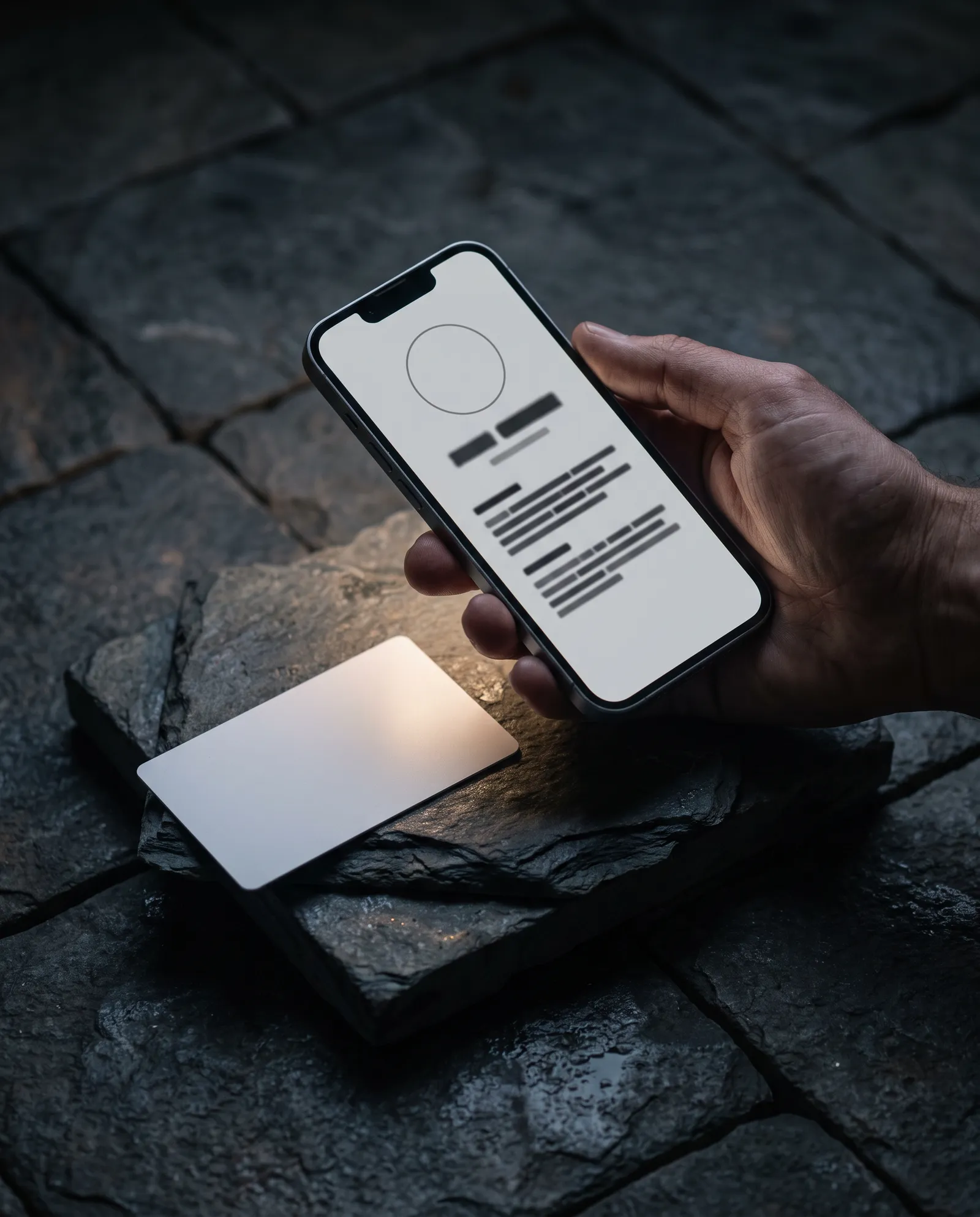
Plastic business cards are worth it when the card has a hard life or the material is the message. Trainers, chefs, bartenders, contractors and anyone who hands cards over in the rain get a card that doesn't warp, stain or dog-ear. Brands built on light and transparency get a card that does something paper physically can't: it lets light through.
They're not the right call for everyone. If you want the dent of letterpress, a painted edge or the warmth of cotton, plastic can't give you that, and we'll tell you so. If you're printing thousands for a trade show and most will be glanced at once, 20pt Standard does the job without paying for 30pt.
If we were making one plastic card for a brand that cares about the object, it would be 30pt frosted with a white layer behind the type and the logo left translucent.
Standard plastic ships in 3–4 business days after you approve the proof; within the US, ground delivery usually adds 1 to 3 business days. Custom plastic takes about 3 weeks after proof approval. These are estimates, not delivery dates.
We don't run rush production on plastic: the timelines are set so the white layer and foil come out right. Standard orders can upgrade to faster shipping at checkout. If you have an event or a launch on a date, tell us the date when you order and we'll say honestly whether it's tight. As a rule of thumb, allow about two weeks for Standard and about four weeks for Custom, proof included.
Send us a PDF and we'll check it before anything prints. The few rules that matter on plastic:
If your artwork started life as an AI image or a screenshot, that's fine. Our designer rebuilds it as a clean vector file with real fonts, and you approve the proof before we print.
More ideas: cool business cards
They're worth it when the card has to survive rough handling or the material is part of your brand. Plastic doesn't warp, stain or tear, and clear or frosted PVC does something paper can't. They're not worth it if you want letterpress, embossing or a painted edge, because plastic can't take those. For a big event run, 20pt Standard is usually enough; for a card people keep in their wallet, 30pt is the better buy.
Standard 20pt plastic cards cost Get a price for 100, Get a price for 250, $284 for 500 and $313 for 1,000. Custom 30pt cards start at Get a price for 250 and cost $410 for 500, with white ink, foil, spot UV and two-sided printing as add-ons. Every order includes a designer's proof and free shipping within the continental US. NFC plastic cards start at $149 for 25.
Our Custom plastic cards are 30pt, about 0.76 mm, which is the thickness of a standard credit card, and they feel like one: stiff and cool with a clean snap. Standard cards are 20pt, about 0.5 mm, so they're lighter and bend more. Both come in credit-card size (3.375 × 2.125 in) or US standard (3.5 × 2 in). For paper, see our guide to business card thickness.
Ours are PVC (polyvinyl chloride), the rigid plastic used for credit cards, hotel key cards and membership cards. It comes clear, frosted, white or black. PVC doesn't absorb ink the way paper does, so colour sits on the surface, and on clear or frosted stock it stays see-through unless a white layer is printed underneath.
Yes. PVC doesn't absorb water, so a plastic card can be rained on, splashed at a bar or wiped clean without warping or going soft. The printed surface can still scuff with years of hard wear in a pocket; frosted plastic hides scuffs best because the matte surface diffuses them.
Clear cards are fully transparent and glossy: you see straight through them. Frosted cards are translucent: light passes through a soft matte surface, so you see shapes and shadows but not detail. "Translucent" and "transparent" are often used for both. Frosted is easier to design for because colour and small type read better; clear is more dramatic but needs bold, dark artwork or a white underprint.
Yes, on our Custom 30pt line. We print an opaque white ink layer first, either as a design element on its own or underneath colour so the colour reads solid. Without it, white artwork on clear plastic simply disappears, and colour on black plastic barely shows. On black cards, very small light-coloured type is crisper in foil than in white ink.
Yes, two-sided printing on clear and frosted plastic is available on Custom; Standard clear and frosted cards print on one side. Because the plastic is see-through, the back always shows through the front. We design both faces together: one side carries the detail and the other stays mostly open, so the layering looks intended rather than muddy.
Yes to both. QR codes print in flat dark ink, at least 2 cm square, and on clear or frosted plastic we print a white patch behind the code so phones can read it. NFC cards have a chip and antenna sealed inside 30pt white PVC; tapping the card to a phone opens your link. On clear and frosted plastic the antenna would be visible, so NFC plastic is built on white unless you want the coil on show.
Plastic can be foiled, but not embossed, debossed or letterpressed. Those techniques press a die into soft paper fibre and leave a permanent dent; PVC has no fibre, so it springs back or stress-marks. Foil works well, especially silver or gold on black or frosted plastic, and we confirm every foil-on-plastic job before the die is made. For texture you can feel, choose raised gloss or foil; for a deep impression, choose thick cotton.
Standard plastic comes in credit-card or US standard size with rounded corners included. Custom shapes, larger formats and unusual sizes are quoted per job, because each shape needs its own cutting die. Send us the outline and we'll confirm it can be cut cleanly before you pay.
Standard ships in 3–4 business days after proof approval (estimate), plus shipping. Custom plastic takes about 3 weeks after proof approval. These are estimates, not guaranteed delivery dates. We don't offer rush production, but Standard orders can upgrade to faster shipping at checkout. If you have a date, tell us when you order and we'll tell you straight whether it's tight.
ID badges, key cards, membership and loyalty cards, gift cards, barcodes and runs over 2,000 are custom-quote jobs, not part of our business card lines. Anything that has to work with a reader, whether that's a barcode scanner, a door lock or a till, we check before we take it on. Tell us what the card has to do and we'll confirm what we can build before you pay. For a business card with a chip, our NFC plastic cards are the ready-made route.
Mostly their phone: a digital profile, a QR code, or a card with an NFC chip that opens a link when it's tapped. A plastic card can carry the first two and hand over the third. Print a QR code on the back, or choose an NFC plastic card with the chip sealed inside, and the person across the table gets your name in their hand and your link on their phone. And the printed side still does its job when someone's phone battery doesn't.
We make them on both lines: Standard 20pt clear from Get a price for 100, and Custom 30pt clear with a white layer behind the artwork from Get a price for 250. We're not the cheapest plastic card online and won't pretend to be. What the price includes is a designer's proof that catches the thing that most often goes wrong on clear (white and pale artwork disappearing) before anything prints. If cost decides it, the per-card price is lowest on larger Standard runs, and frosted or white plastic will forgive a design that clear won't.
Yes. On clear, ink tints the plastic instead of covering it, so white and pale colours vanish and thin type goes faint. Use bold, dark marks, or put a white layer behind anything that has to read solid (a Custom add-on). The back shows through the front, so design both sides together, and give a QR code a white patch to sit on. Our designer checks all of this at proof, and our guide to designing for plastic cards walks through the file setup.
Order the sample kit to hold frosted plastic next to our paper and metal, or send us your artwork and we'll tell you which plastic suits it, what to drop, and what it costs. If anything feels sideways, book a 15-minute call and we'll go through it with your design open.
Who orders these: contractors, roofers and crews whose cards live in a truck. See our construction business cards.